Topics
Topics
AI Readiness Check: Five Signs Your Organisation Is Ready for AI Agents
Published on
November 23, 2026
Reading time
6 minutes


At a Glance
- Many AI pilots work but fail to scale because the necessary organisational foundations are missing.
- AI readiness describes how well the target vision, data, processes, governance and team members are prepared for the productive use of AI.
- Five signals in day-to-day work reveal where an organisation’s readiness gaps lie.
- These gaps become particularly critical as soon as AI agents act autonomously within the CRM system and across departmental boundaries.
- Salesfive’s AI Readiness Check reveals your organisation’s current position in just a few minutes and shows where you should take action.
Why AI Pilots Rarely Scale
An AI pilot in customer service answers standard enquiries faster than expected, and the demo convinces management. Yet six months later, only the initial project team uses it. Additional budget, clear responsibilities and an answer to what the pilot should actually improve are all missing for the rollout. Does this sound familiar?
Willingness to invest is rarely the issue. Implementation, however, often is: according to Lünendonk’s 2025 “AI Transformation” study, only 30% of companies succeed in moving more than a quarter of their AI prototypes into operational use. According to the study, the main reasons lie within the organisation.
What a small team can coordinate informally in a pilot project requires a clear structure when deployed across the organisation. As organisations introduce AI agents that carry out tasks independently, this structure becomes even more important. Their level of maturity often becomes clear through simple observations from day-to-day work.
Only 30% of companies succeed in moving more than a quarter of their AI prototypes into operational use.
What Does AI Readiness Mean?
AI readiness describes how well an organisation is prepared organisationally, functionally and technically for the productive use of artificial intelligence (AI). This includes a clear target vision, available and consistent data, documented processes, defined governance and employees who support the change. An AI readiness check systematically assesses these areas and identifies where gaps are blocking the path from pilot to productive use.
In many organisations, this particularly affects the Customer Relationship Management (CRM) system. It contains customer data, sales processes and service cases that AI agents will use in the future. AI readiness in the CRM therefore directly determines how reliably agents can operate in sales, service and marketing.

Scale AI Agents Across Sales, Marketing and Service
Build the right foundations to deploy AI agents reliably, automate routine tasks and ease the workload for your teams. Our CRM and AI specialists support you every step of the way.
Five Signs of Missing AI Readiness
The following five signals provide a quick way to assess your organisation's AI readiness. They describe situations that management, IT and business teams often encounter without necessarily identifying them as AI-related. Each signal can be addressed and serves as a starting point when the journey from an AI pilot to productive use encounters obstacles.
No one can say which KPI needs to improve
A pilot is under way and the team is satisfied. However, when asked which KPI it is intended to improve, there is no clear answer. This is one of the most common signs of insufficient readiness.
A robust target vision is more than the desire to use AI. It identifies a specific business problem and a measurable indicator of progress – for example, reducing service request processing times by a quarter or shortening the time between initial contact and quotation. Only with such a target can organisations compare and prioritise use cases effectively.
Horváth’s Digital Value Study highlights the scale of this gap: only 52% of surveyed companies have an up-to-date, overarching digital strategy with clear objectives for all business areas. Just 44% regularly measure the value contribution of their digitalisation initiatives. Without a clear target vision, pilots lack direction, and without success measurement, there is no evidence that the investment delivers value.
Critical knowledge resides in people’s minds rather than in the system
An experienced sales professional knows which customers require management approval for discounts, which customer expects a specific contact person for enquiries, and which field in the CRM system the sales department completes differently from the service team. None of this is documented. Yet as long as the same person carries out these tasks, it is barely noticeable.
An AI agent does not recognise such exceptions. It only uses experiential knowledge when it is explicitly available in rules, instructions or a knowledge base. The same applies to data: for an agent to work reliably, data must be accessible, consistent and sufficiently up to date for the specific use case.
Documentation and well-maintained data deliver value beyond AI: Defining fields, formats and responsibilities for a process, and recording practical knowledge, also improves reporting, onboarding and operational resilience.
Processes only work because someone bridges the gaps
A quote moves from Sales to Order Processing, a complaint from Service to Accounting. To keep everything on track, someone sends a brief follow-up message, adds missing information or clarifies exceptional cases by phone.
People compensate for such gaps, often without even noticing. However, an AI agent processing a case across multiple departments gets stuck at each of these points or makes an incorrect assumption.
This becomes particularly clear in the CRM system: if each department records opportunities, contacts or service cases according to its own rules, an AI agent works with conflicting information. Before organisations deploy an agent to a process, they should therefore review its handovers: where are they clearly defined, and where do they depend on individual team members?
No one knows which AI tools are in use
Employees use AI tools for writing, research or analysis, often without IT being aware of it. This so-called shadow AI is widespread: Horváth reports that 62% of companies lack an overview of the AI applications used internally.
As long as AI only supports team members, the risk remains manageable. As soon as AI agents act independently – by changing records, contacting customers or triggering processes – clear rules are essential. Organisations must define which systems and data an agent may access, who is accountable for its outcomes, which decisions it may make independently and where human approval is required.
Pilots do not scale and are never completed
Some pilots continue for months without anyone deciding on their future. They are neither rolled out productively nor discontinued. At the same time, team members do not know what the planned use cases mean for their tasks and roles.
Both are closely linked. Without defined criteria and responsibilities, it remains unclear when a pilot is considered successful and who decides on the roll-out. Without involving employees, the acceptance and skills required to use a solution in day-to-day work are lacking. Scaling is therefore not a question that only arises at the end. It needs to be part of the planning for every pilot from the outset.
Does Every AI Application Require This Preparation?
No. An AI assistant that drafts emails or summarises long texts delivers immediate value, even when many other areas of the organisation remain unresolved. These applications are largely self-contained: they receive a clearly defined input, generate an output and rarely interact with upstream or downstream processes.
What matters, therefore, is not whether a task is simple or complex, but how heavily it depends on cross-system processes, a shared data foundation or clearly defined responsibilities. The greater this dependency, the more AI readiness determines success.
For the Agentic Enterprise, where numerous AI agents collaborate across departmental and system boundaries, this applies to virtually every relevant use case.
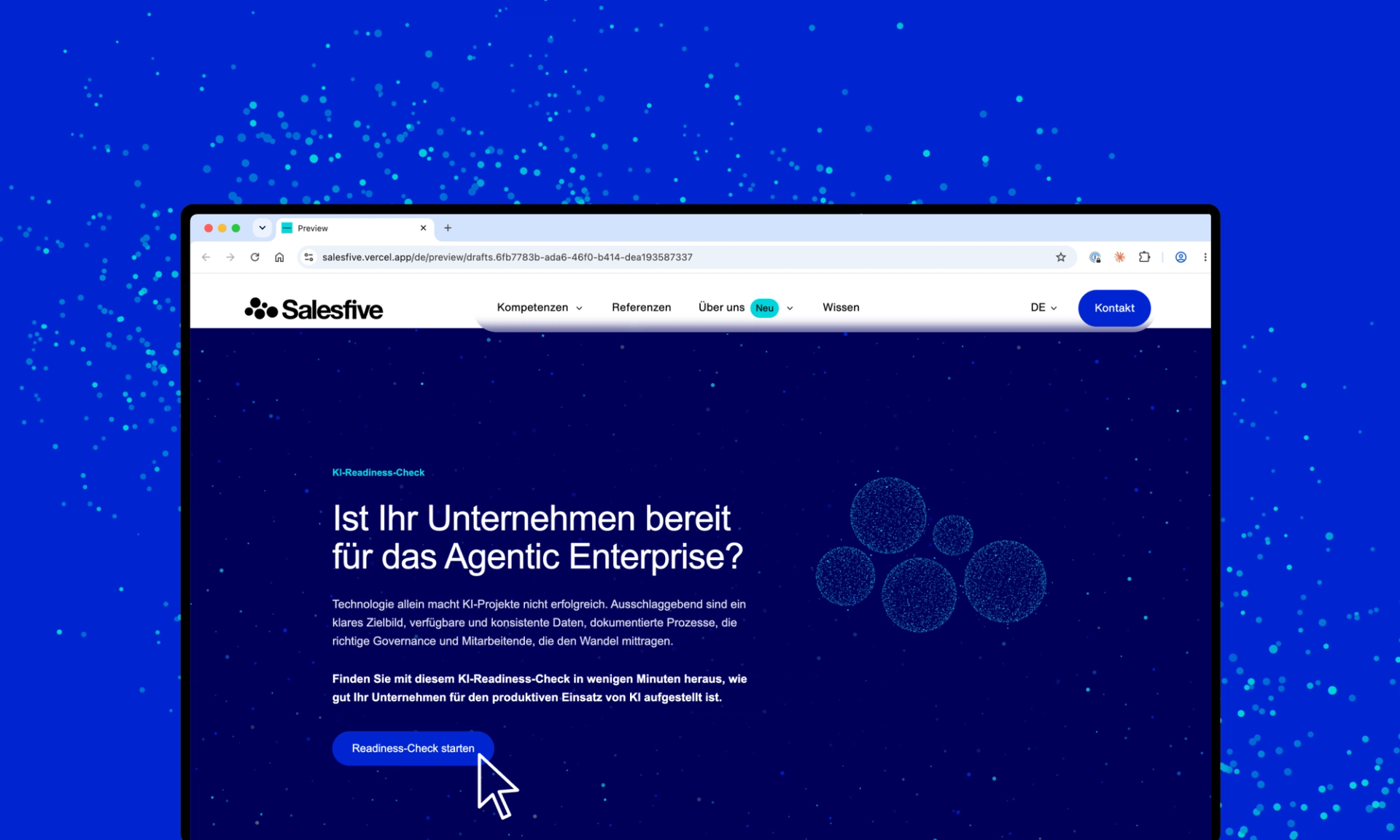
Is Your Organisation Ready for the Agentic Enterprise?
A clear target vision, consistent data, documented processes, the right governance and team members who support change: take the test to see where your organisation stands.
How Does the AI Readiness Check Work?
The five signals show where typical gaps arise. The Salesfive AI Readiness Check helps you assess how pronounced they are in your organisation in just a few minutes.
The AI Readiness Check includes ten statements. They cover the areas described in this article as signals and break them down in greater detail – from vision to scaling. The total score results in one of three classifications: Explore, Prepare or Scale, each with a recommendation for the next step.
The check does not replace a thorough analysis, but it provides a starting point.
Structure Before Scaling
Why AI pilots so rarely scale has little to do with the underlying technology. Goals, knowledge, handovers, rules and responsibilities are simply not ready for implementation.
The good news: you can identify and address these five signals in day-to-day operations. By documenting knowledge, clarifying process handovers and defining rules for autonomous decisions today, you create the foundation for AI agents to operate reliably in the CRM system and beyond. With every additional agent, the advantage grows for those who complete this work early.
Next Step: From Readiness Check to Roadmap
The AI Readiness Check shows you how well your organisation is prepared to use artificial intelligence. An AI Readiness Assessment goes one step further: it identifies specific gaps and shows you which measures to prioritise. This creates a clear roadmap for your next steps.
Arrange a no-obligation consultation with our experts. Together, we explore how you can benefit from the assessment and which measures will create the greatest value for your organisation. Get in touch!
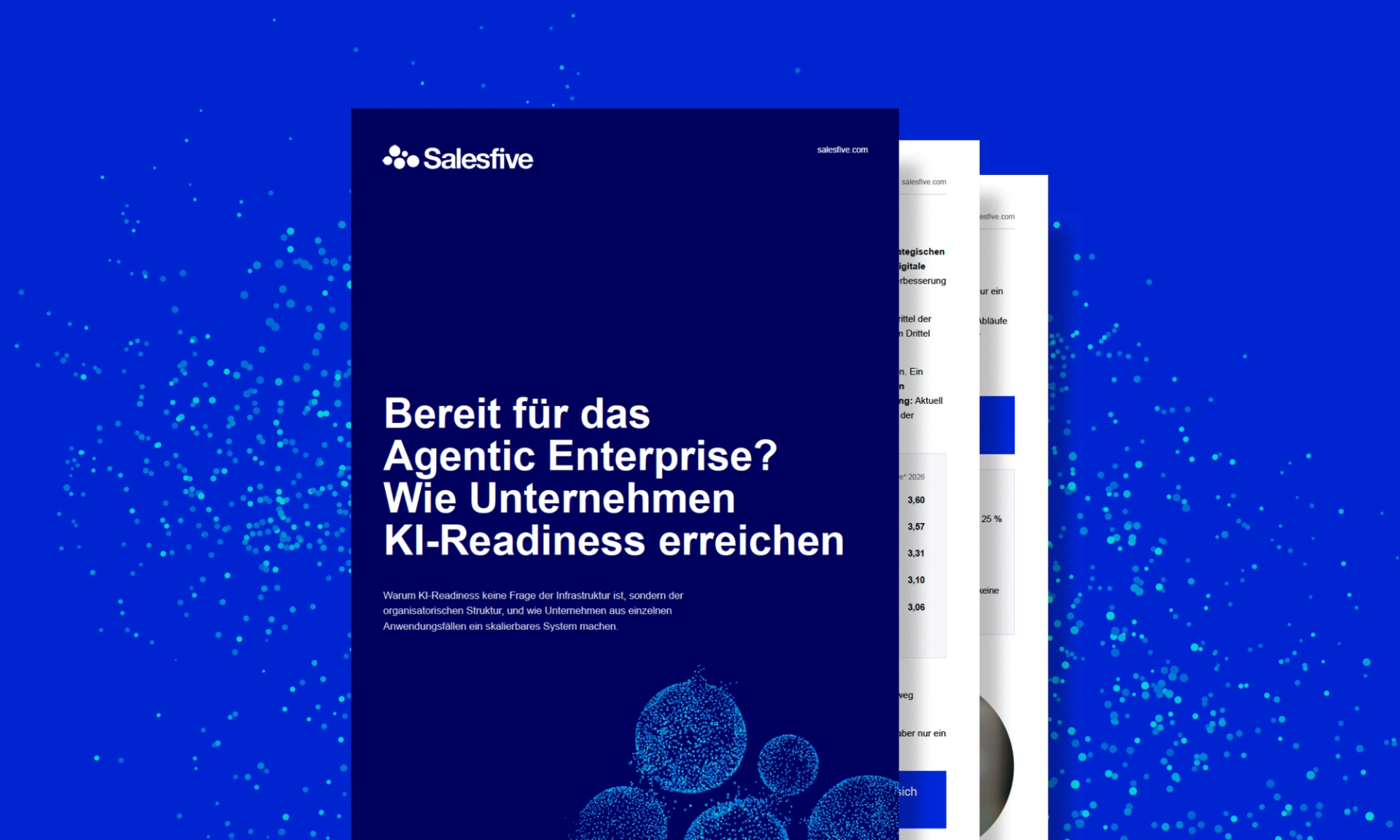
In-Depth Insights into Research Findings, Solution Approaches and Use Cases …
… is explored in our whitepaper “Ready for the Agentic Enterprise? How Businesses Achieve AI Readiness”.