Topics
Topics
Implementing AI in Your Organisation: 5 Requirements to Move Beyond the Pilot Phase
Published on
November 13, 2026
Reading time
6 minutes


At a Glance
- According to Lünendonk, only 30% of companies move more than a quarter of their AI prototypes into production.
- Scaling means transferring successful AI use cases to further processes and business areas rather than introducing more AI tools.
- Five prerequisites determine whether an AI implementation is sustainable: business value, data foundation, processes, governance and organisational integration.
- Once you establish these foundations properly, you do not need to rebuild them for every additional AI use case.
- AI readiness is not a characteristic of a dedicated project, but an organisational capability.
Why Do AI Projects Remain Stuck in the Pilot Phase?
AI projects do not progress beyond the pilot phase if one of five prerequisites is missing: a use case aligned with business value, a robust data foundation, documented processes, defined governance or organisational integration within the business. Technical feasibility rarely proves to be the issue.
For many organisations, the question of whether artificial intelligence (AI) can be introduced and deliver results has long been answered: a prototype in customer service, an AI assistant for proposal creation, or automated analysis in controlling.
The technical proof is now achieved quickly. The next step is far less common. The Lünendonk study “AI Transformation – From the Experimental Phase to Productive Scaling” shows that only 30% of surveyed companies move more than 25% of their AI prototypes into operational use. The study authors identify the causes not in the technology, but in change management and data quality.
Fivetran’s Agentic AI Readiness Index 2026 reaches a similar conclusion: only 15% of surveyed organisations consider themselves fully prepared to operate AI agents productively. Yet almost 60% are already investing millions.
The reason for this discrepancy rarely lies in the pilot project. A pilot works with selected data, a manageable use case and a committed project team. Once in live operation, these conditions change.
AI Must Work With Real Business Data. It must fit into existing processes, be genuinely adopted by team members and remain reliable even as case volumes increase.
Companies that address these requirements early embed AI sustainably into their value creation. They scale it rather than merely testing it in isolated use cases.
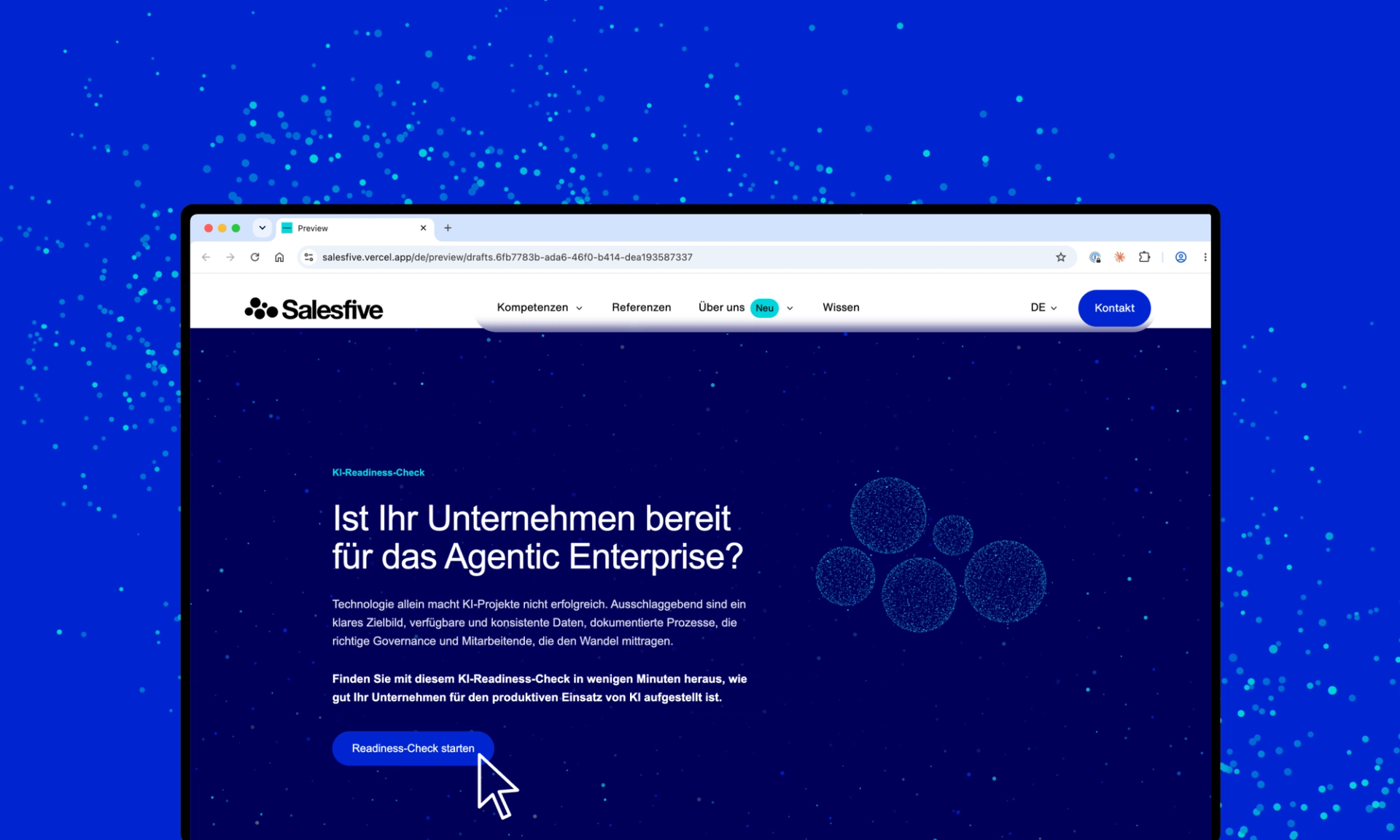
Are You Ready for the Agentic Enterprise?
A structured assessment shows how well your organisation already meets the requirements. Salesfive’s AI Readiness Check provides an initial overview.
What Does Scaling Mean in AI Implementation?
Scaling AI implementation means extending a proven use case to further processes, teams or business units while maintaining reliable day-to-day operations. It does not mean introducing as many AI applications as possible at the same time.
Their impact is evident in three areas:
- The level of automation increases because a process is supported end to end rather than in individual stages.
- Decisions become more consistent because the same logic applies across all areas.
- Lead times are reduced because manual handovers are eliminated.
The foundations established for the initial use case are then available for all subsequent ones. This means that a cleansed data foundation, documented processes and defined access rights are not project costs. They are an investment in the organisation’s overall AI capability – its AI readiness. As a result, the second use case typically becomes productive significantly faster than the first.
What Are the 5 Requirements for Successfully Implementing AI in Your Organisation?
The following five requirements are decisive in practice in determining whether AI adoption progresses beyond the pilot phase. Each section outlines the typical challenge, the specific recommended action and the benefit to the organisation.
A technically interesting use case does not automatically have strategic relevance. Many pilot projects start where data is readily available or where a business unit is particularly open to innovation. Whether the use case is relevant to the business model is often only clarified later.
Companies should therefore define objectives and KPIs before implementation begins. They then systematically assess and prioritise use cases according to business value and feasibility. An honest analysis is essential: How long does the process currently take? What is the error rate? And how often does the use case actually occur?
This approach ensures that resources flow into applications that deliver real value. And because a benchmark exists, you can demonstrate after the pilot project whether scaling is commercially viable.
A pilot usually works flawlessly with selected or manually prepared data. In day-to-day operations, however, AI must work with the data stored in the systems: duplicates, incomplete fields, legacy data and information maintained in several locations at the same time. People can still interpret this data. In an AI application, however, it leads to incorrect results or system failures.
For organisations, this means identifying relevant data sources, assessing quality and availability, breaking down data silos and integrating the systems involved. Within the Salesforce ecosystem, Data 360 fulfils this role as the data layer. It consolidates information from internal and external sources into a consistent profile and makes it available to applications.
AI tools can therefore access up-to-date, validated information and deliver more reliable results. At the same time, this creates a foundation that every additional use case can leverage.
An inadequately defined process does not improve through AI – it simply gets stuck faster. When scaling, organisations often find that a workflow differs across each branch or that half of all cases are subject to special rules that have never been documented.
They should therefore document workflows, make process variations and exceptions visible, and determine which steps can be automated and which are better handled by a person. Often, standardising the process delivers a greater benefit than the AI functionality itself.
This ensures that AI is deployed where it genuinely reduces workload. It also minimises the risk of simply automating existing inefficiencies and thereby embedding them further.
The more deeply AI is embedded in operational processes, the more important clear responsibilities and control mechanisms become. As long as an application only makes recommendations, this remains manageable. Once it operates as Agentic AI and independently changes records, creates quotes or closes cases, it requires clear boundaries.
This requires organisations to define roles and access rights. They need to establish decision-making and escalation thresholds, as well as monitoring that provides full traceability of what an AI application has done and on what basis.
Ultimately, organisations should use AI within defined guardrails and expand responsibilities gradually where needed, rather than limiting or delegating them indiscriminately.
Governance Is Also a Key Requirement for the Agentic Enterprise, where people and AI work together on a single platform and AI agents independently carry out process steps. Autonomous agents depend on the governance that many organisations overlooked in their initial AI applications.
A pilot can be delivered by a small project team. Scaling, however, involves significantly more people and business areas, including colleagues who did not propose the use case themselves.
However, they only use the AI application if it clearly reduces their workload. Organisations should therefore establish clear responsibilities, involve business units at an early stage, build capabilities and prepare employees for new ways of working. This ensures AI does not remain a standalone IT project but becomes a productive part of day-to-day work. Its value is realised where it is intended to be measured.
The 5 Requirements for Successful AI Implementation at a Glance
Prerequisite | Challenge | Measure | Benefits |
|---|---|---|---|
Business Value | Technically Interesting Use Cases Without Strategic Relevance | Define Objectives, KPIs and Baseline, Prioritise Use Cases | Resources Flow into Effective Applications, Making Scalability Measurable |
Data Foundation | Pilot Data Is Prepared, but Real Data Is Not | Review Data Sources, Break Down Silos, Integrate Systems | More Reliable Results and a Foundation for Further Use Cases |
Processes | Undocumented Processes and Unclear Exceptions | Document Processes, Visualise Variants and Define the Level of Automation | AI Can Reduce Workloads Rather Than Reinforce Inefficiencies |
Governance | Growing Autonomy Without Defined Boundaries | Define Roles, Access Rights, Escalation Rules and Monitoring | Clear Guardrails and Gradually Expandable Responsibility |
Organisation | Scaling Affects More People Than the Pilot | Establish Responsibilities, Engage Business Units and Build Capabilities | AI Is Actively Used and Delivers Impact in Day-to-Day Work |

Scaling AI Rather Than Just Testing It
Successful AI adoption is primarily not a question of infrastructure, but of organisational structure. In our whitepaper, we discuss in detail the five key considerations that will support you on your journey towards becoming an Agentic Enterprise.
Why Does AI Readiness Make Scaling Repeatable?
AI Readiness Is an Organisation’s Level of Maturity in relation to its data, processes, governance and organisational structure. It determines whether AI applications can be operated productively and scaled. AI readiness is therefore not a characteristic of a specific project, but of the organisation itself.
The five prerequisites only deliver results when they work together. A sound data foundation achieves little if the process itself remains unclear. A clearly prioritised use case stalls if no one takes responsibility for it. And a technically compelling solution adds no value if the business teams do not adopt it.
With strong AI readiness, this foundation is not rebuilt for every pilot project. Instead, it is established as a shared foundation for all AI applications and continuously maintained. An organisation that consolidates its customer data, documents its service processes and regulates access rights for AI applications does not have to start again from scratch with the next use case.
From an economic perspective, this delivers a key advantage: The first use case justifies the investment. Every subsequent use case benefits from it without incurring the cost again. This repeatability distinguishes individual successful AI projects from scalable AI adoption across the organisation.
Next Steps for Implementing AI in Your Organisation
Whether an AI implementation continues beyond the pilot phase depends on five factors. First, it needs a use case with a measurable business impact. Second, the data must remain reliable in day-to-day operations. Third, the processes must be documented. Fourth, governance must evolve in line with the application's autonomy. Fifth, the business units need clear responsibilities. None of these requirements is technical, and none can be compensated for retrospectively with greater computing power.
Most efforts are one-off. Once you consolidate customer data, define service processes and establish access rights for AI applications, you can use this foundation for every additional use case. The question is no longer whether an AI application can go live. Instead, it is about which application delivers the greatest value to the organisation next.
This results in three key steps for organisations:
- Assess Use Cases: Which use cases address a relevant business lever and can be implemented with the data available today?
- Identify Gaps: Where are data quality, process clarity, responsibilities or capabilities lacking for ongoing operations?
- Prioritise the Fundamentals: Rather than tackling everything at once, start with what the first scalable use case actually requires.
Once data, processes and governance are in place, the foundations for agent-based scenarios are also established, enabling AI to carry out process steps independently.
Companies that invest in AI readiness now also determine how quickly they can implement the Agentic Enterprise.

Are You Looking to Plan Your Next AI Use Case?
Our specialists support you with data analysis, process design, governance and implementation on the Salesforce platform.