Topics
Topics
Agentforce – Everything You Need to Know about Costs, Tools and Integrations
Updated on
July 17, 2026
Reading time
6 minutes


At a Glance
- Agentforce has enormous potential: it increases efficiency, automates processes and strengthens customer loyalty.
- Unlike classic AI functions, Agentforce acts independently: It makes decisions and can be deployed across the entire Salesforce ecosystem.
- Agentforce offers various pricing models: in addition to usage-based billing, user-based models and a per-successful-solution billing option are also available.
- With the low-code tool Agent Builder, users can create their own AI agents or customize templates flexibly.
- Salesforce partners can offer their agents via the AgentExchange platform and companies can benefit from the developments of others.
Table of Content
Agentforce – What is it?
“Our vision is bold: to empower one billion agents with Agentforce by the end of 2025. This is what AI is meant to be.” Marc Benioff, CEO of Salesforce, presented Agentforce with this vision in September 2024.
Agentforce is the autonomous AI application from Salesforce. Digital assistants, so-called AI agents, complete tasks independently. They answer questions, draw conclusions, make decisions and interpret correlations. In this way, they increase the productivity of companies.
Predictive AI has been analyzing historical data for decades to predict trends and behaviors. Generative AI goes further: it generates new content based on existing information. Tools such as ChatGPT have made it popular. Agents are the next evolutionary stage. They act independently, imitate human communication and create new things – proactively and with foresight.
Agentforce vs. Einstein: What’s the Difference?
Since autumn 2024, Salesforce has increasingly focused on autonomous AI agents with Agentforce. At the same time, the well-known Einstein features remain part of the Salesforce ecosystem. But how are Einstein and Agentforce connected?
In short: Today, the two can no longer be clearly compared as separate AI solutions. Einstein continues to represent various AI features within Salesforce, while Agentforce extends these capabilities with autonomous action.
Einstein supports employees, for example, with predictions, recommendations and generative features. Based on existing data, the AI can, among other things, predict customer behaviour, optimise send times in campaigns or recommend suitable content.
Agentforce goes one step further: The AI agents act independently, proactively suggest actions, carry them out and make decisions, for example when prioritising tasks. In doing so, Agentforce operates largely without human intervention. The agents can access structured and unstructured data, for example from CRM records, emails, conversations or other natural-language content. Each AI agent follows a defined area of responsibility.
Instead of viewing Einstein and Agentforce as two separate products, Agentforce can therefore be understood as the further development of Salesforce AI towards autonomous agents. Salesforce is increasingly bringing this development together on the Agentforce 360 Platform.
While traditional Einstein features support employees, Agentforce can independently take over entire work steps.
Einstein | Agentforce | |
|---|---|---|
Artificial Intelligence | Predictive and generative AI | Autonomous AI agents |
Function | Predictions, recommendations and generative functions | Own decisions and proactive action |
Mode of Operation | Supports employees with their tasks | Takes on tasks mostly independently |
Area of Application | AI features within Salesforce | Task-related agents in the Salesforce ecosystem |
Data Processing | Structured and unstructured data | Structured and unstructured data |
Agentforce and Data 360
Artificial intelligence only delivers strong results if the database is right. This requires reliable, high-quality data. One good measure is Salesforce Data 360, formerly Data Cloud, as data storage. It can be activated free of charge. However, the free version has potential sources of limitation.
Companies that do not use Data 360 should carefully review their data structure. Superfluous information should be deleted. Every data entry must be validated, otherwise it can be removed.
Experienced Salesforce users in particular often rely on workarounds or work with inconsistent data. This is a problem for AI tools such as Agentforce: they only work with clear, consistent data.
A planned Agentforce implementation can be the ideal occasion for companies to prioritize data cleansing and get rid of legacy issues.
MuleSoft for Agentforce: Seamless Integration of Third-Party Providers
Agentforce is deeply connected to Salesforce systems such as Sales Cloud, Service Cloud, Slack and Tableau and can use their data directly. However, the potential is not just limited to Salesforce. Agentforce can be flexibly connected to external systems such as ERP solutions, cloud services or collaboration tools – via APIs, connectors and integration platforms such as MuleSoft.
The MuleSoft Agentforce Connector creates the bridge between Salesforce and third-party systems. Agentforce can thus retrieve, use and process information from external sources. The MuleSoft Anypoint Platform and the Anypoint Code Builder provide the technological basis for seamlessly integrating the AI agents into existing IT landscapes so that they can interact autonomously with APIs.
MuleSoft guarantees a high level of data security. Data and interfaces can be centrally managed, controlled and secured. In addition, the Einstein Trust Layer protects sensitive information from unauthorized access, both in Salesforce and in external applications.
Thanks to the integration, companies can access third-party data directly from Agentforce. This includes customer, financial and operational data. Access is fast and efficient, even if the data is not stored in Salesforce.
With MuleSoft Agent Fabric, Salesforce extends this approach by providing orchestration and governance for AI agents across different systems. It enables organisations to make AI agents and their capabilities discoverable, connect them and manage them centrally. As a result, MuleSoft is increasingly becoming the integration and governance layer for enterprise environments where different AI agents, APIs and applications work together.
What Does Agentforce Cost?
Flex Credits: The Consumption-Based Pricing Model
Salesforce is taking a new approach with Agentforce: instead of traditional licensing models, it is relying on a AI consumption-based pricing model for the AI platform. To this end, it has introduced so-called Flex Credits.
Flex Credits ensure that companies only pay for the actions that Agentforce actually carries out. An action can be the updating of customer data records, the automation of complex workflows or the processing of use cases. Each of these actions consumes 20 Flex Credits, which corresponds to 0.10 Dollars. An Agentforce action costs 0.10 Dollars. Different values apply to certain actions, such as Voice Actions.
Companies can buy Flex Credits in packages of 100,000 credits at 500 Dollars each. In the Salesforce Digital Wallet, they can then manage their credits and strategically assign them to individual use cases – and thus optimize the impact of their AI agents.
With the pricing model, Salesforce promises its customers control and profitability. For the idea of AI agents is to automate processes and reduce or even eliminate human intervention. So if you use Agentforce specifically where there are efficiency gains, you will achieve immediate added value. Ideally, the revenue generated by Agentforce will exceed the costs of use.
What is particularly attractive is that there are no major hurdles to getting started. Companies do not have to pay high license fees to gain initial experience or implement a proof of concept.
At the end of the day, there is a clear cost-benefit analysis. The AI agent takes over tasks that would otherwise tie up human resources – faster, cheaper and for a better customer experience. For this evaluation, Salesforce provides a free Agentforce ROI calculator on its website.
The Flex Credit system was expanded in May 2025 with the announcement of Agentforce user licenses and add-ons, available since Summer 2025. These user licenses and add-ons operate as a separate, user-based pricing model (per user per month) and are not an extension of Flex Credits themselves, but rather an additional purchasing option alongside the consumption-based model.
The Conversation-Based Pricing Model
The old conversation-based pricing model continues to apply to existing Agentforce contracts: each conversation with Agentforce costs two dollars. This means that as soon as an employee, partner or customer sends at least one message to the AI agent within 24 hours or selects a menu option that does not end the chat, a conversation is charged. Salesforce offers individual price agreements for companies with high conversation volumes.
Pay-Per-Resolution for Agentforce Help Agent
In July 2026, Salesforce expanded its pricing portfolio to include another model: Pay-per-Resolution. It currently applies specifically to Agentforce Help Agent as well as the associated Agentforce Customer Service Portal.
The principle: Companies pay only when their AI agent independently and completely resolves a customer issue. If a case is escalated to an employee or if customers report that they did not receive a solution, no charges apply. The price per successful resolution is expected to be around 2 Dollars, typically purchased in packages of 1,000 resolutions.
Important: Pay-per-Resolution does not replace the existing Agentforce pricing models. Salesforce continues to offer a range of usage-, user- and performance-based billing models, which are applied depending on the product and use case.
Use Agentforce Free of Charge
The Foundations add-on to the Sales Cloud and Service Cloud Enterprise Edition provides companies with a free access to Agentforce.
The package includes 100,000 Flex Credits to test Agentforce – including the Agentforce Builder and ready-made skills such as Service Agent, SDR Agent and Sales Coach. 100,000 Flex Credits correspond to 5,000 Agentforce actions.
How to Create an AI Agent with Agentforce?
Until now, developing an AI agent required a great deal of effort and programming knowledge. Agentforce fundamentally changes this: with natural language and just a few clicks, an agent can be created that is directly integrated into Salesforce. Coding knowledge is no longer necessary.
This is made possible by the Agent Builder, an AI-supported low-code tool. It manages data sources and allows you to create an Agentforce agent intuitively and in just a few steps. It also provides a library of actions that an agent can perform.
Salesforce has significantly expanded the Agent Builder. Within a single workspace, users can build, test and prepare agents for deployment. They can use natural language to define the tasks an agent should perform and use testing and debugging tools to verify its behaviour.
Users define the scope within which their agent can operate and provide clear instructions on how it should carry out its tasks. They can do this by using existing workflows or entering instructions in natural language directly into the Agent Builder interface.
Areas of responsibility that Salesforce previously referred to as “Topics” are now called “Subagents” in the new Agent Builder. This makes it possible to build more complex agents using a modular structure and define specific areas of responsibility for each one.
A live preview and built-in testing tools allow users to check whether the agent responds as intended and completes its assigned tasks.
Agentforce Tools and templates
With Agentforce, companies can develop unique AI agents that are perfectly tailored to their requirements. They can design these agents from scratch – or use existing Agentforce functions and adapt them flexibly to their needs:
The Sales Development Agent (SDR Agent) relieves sales teams so that they can focus on deeper customer relationships. It interacts with customers and prospects around the clock. Based on external and Salesforce data, it answers questions and arranges meetings without errors. Companies themselves control which channels the agent uses to communicate, when it becomes active and when employees take over.
Agentforce can do more than just answer questions. The sales coach strengthens sales teams through targeted training. He practises pitches, simulates negotiations and gives specific tips on how to respond to recurring objections. He also provides real-time feedback on employees' individual strengths and where they can improve.
The service agent conducts personalized customer conversations around the clock and in natural language. It answers standard questions independently on the basis of company data. It automatically forwards more complex cases to the service team.
Agentforce for Field Service supports dispatchers and technicians in the field. The AI agent plans appointments, optimizes the allocation of resources and helps technicians on site to rectify faults. It also creates reports automatically. Agentforce for Field Service is compatible with industry clouds such as the Manufacturing Cloud, the Energy & Utilities Cloud and the Communications Cloud.
The HR Service Agent gives employees direct access to relevant information. They update data, manage leave requests, monitor employee programs and manage expense reports. They escalate tasks outside their area of responsibility to the responsible HR representative. This leaves more time for personal support with more complex issues.
Agentforce also supports employees directly in Slack. You can call up the agent via personal messages or mentions in channels. Agentforce creates canvases and lists, sends messages and accesses conversation data via the search function.
With AgentExchange, Salesforce provides partners and customers with a central marketplace for Agentforce solutions. It offers pre-built agents and skills, as well as apps and other solutions from Salesforce and its partners. The marketplace now features more than 1,000 agents and skills.
This allows organisations to build on existing components and tailor them to their specific requirements rather than developing every use case from scratch.
How Can the Success of AI Agents Be Measured?
Decision-makers must be able to understand the specific added value Agentforce offers for their use case. This is where Salesforce's Agentic Maturity Model comes in. It provides orientation, makes progress measurable and shows how far companies have already come in the use of agent-based AI. The framework defines five maturity levels for this purpose.
The framework shows how the agents work, where there is potential for optimization and where the ROI is. This makes it a strategic basis for companies to further develop and scale their agent solutions in a targeted manner.
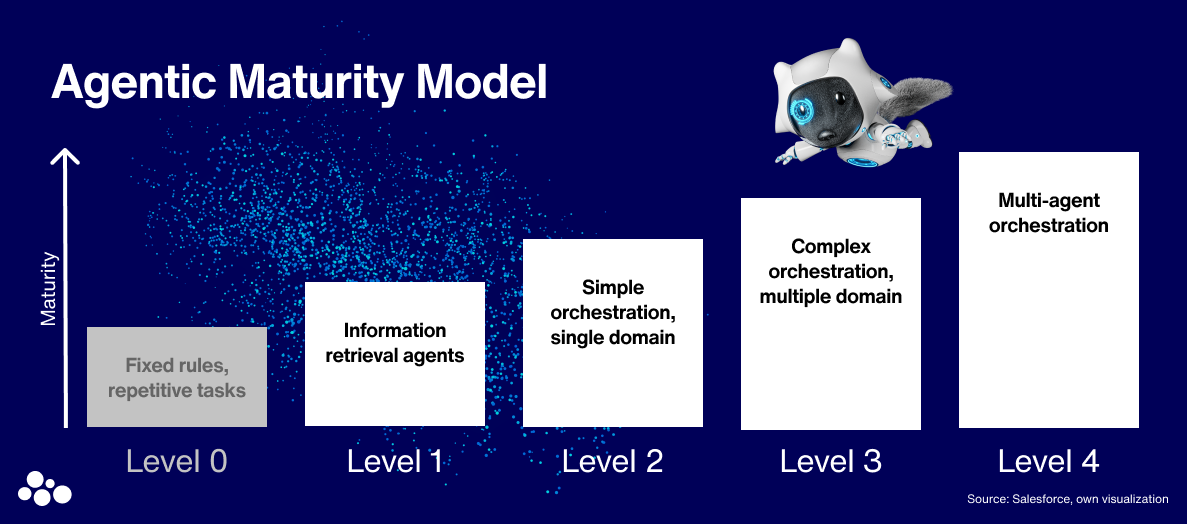
The AI follows fixed rules and performs recurring tasks. They are not yet agents, but simple chatbots or co-pilots.
The agents search data sources, filter relevant content and make specific recommendations. This is made possible by the Atlas Reasoning Engine, which captures the user’s intention and retrieves specific information.
Even at this level, measurable business value is created, the basis for any further development.
The agents act on the basis of the determined data (see level 1). They perform tasks of low complexity independently. For example, they can summarize information or cancel a flight ticket – via an API, without human intervention.
Companies in this phase are gearing their agent strategy towards growth. They link their AI initiatives directly to central business objectives.
The agents make decisions independently, prioritize tasks and carry out processes from start to finish – across multiple systems and domains.
This level is currently the maximum that is technically feasible.
No agent has yet reached this level of maturity. But in the future, AI agents will act as part of an intelligent network. They will communicate with each other, coordinate their tasks and effortlessly overcome system boundaries.
The Advantages of Agentforce
Agentforce‘s AI agents are still in their infancy but are already showing their enormous potential. They noticeably increase efficiency, automate processes and ensure fast responses. The result is greater customer loyalty and lower costs while scaling at the same time.
Customers expect fast and uncomplicated communication, anytime and anywhere. If you want to stand out from the competition, you have to take this seriously and deliver. Agentforce offers the right solution, making it a powerful growth driver.