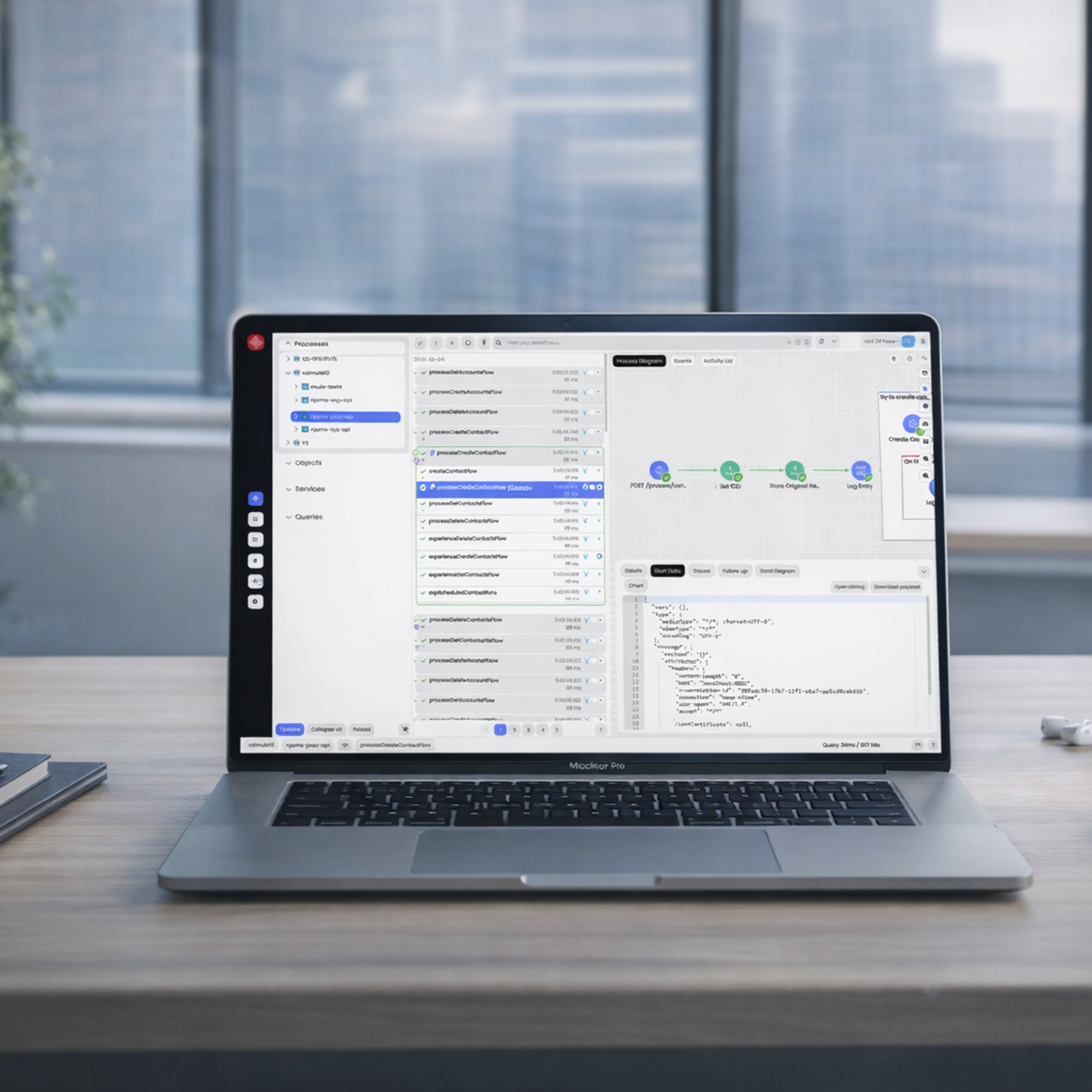
Future-proof, open-source integration
An open-source framework offers a flexible, secure, licence-free integration platform for scalable system architectures and robust digital processes.
A scalable framework for intelligent automation and digital sovereignty
Open-source integration allows companies to securely and flexibly connect different systems, data and processes in a standards-based manner. Based on proven technologies such as Apache Camel, it creates a scalable framework that orchestrates integrations, reduces silos and establishes an adaptable architecture for modern system landscapes.
The major advantage lies in the combination of flexibility, vendor independence and cost-effectiveness. Companies benefit from a licence-free solution that avoids vendor lock-in and allows them to further develop their integration landscape to suit their individual needs. At the same time, they create a secure, scalable and future-proof basis for digital processes. In complex IT landscapes in particular, the solution helps implement innovations more quickly, reduce operational costs, and map new requirements more easily.
Open-source solutions are of particular interest to companies with established or complex system landscapes seeking a flexible alternative to proprietary integration platforms. It is particularly relevant for IT teams wishing to efficiently interconnect CRM, ERP, e-commerce and legacy systems, build long-term strategic integrations and ensure control, scalability and cost transparency.
At Salesfive, we can advise you on using the framework and implement it for you from a technical perspective.

Abdelghani Faiz
Would you like to know whether open-source integration is the right approach for your IT environment? Should you wish to discuss this matter further, please contact me.
Your benefits
More value. Lower costs.
A wide range of companies are using open-source software to efficiently connect complex system landscapes and implement innovative digital business models. The combination of technological openness, flexibility and cost-effectiveness creates an integration framework that can meet both current and future requirements.

Open and flexible
The open-source architecture is designed to provide maximum flexibility for the further development of your integration landscape. Organisations benefit from independence from vendors, avoiding vendor lock-in, and the ability to adapt integrations flexibly to new requirements.

Secure and compliant
Centralised monitoring, clear security policies and robust governance frameworks ensure transparency and control. This approach facilitates the early identification of risks and ensures compliance with regulatory requirements.

Scalable and sustainable
The solution is scalable, meeting the needs of both small businesses and large enterprises. Standardised interfaces and a modular structure facilitate system expansion and ensure cost-effective operation in the long term.

Cost-effective
The open-source approach is characterised by the absence of any licence fees and ensures complete cost transparency. By reducing operational and development costs, companies can establish a sound financial basis for their integration.
Customer Stories
Real-world examples that we have successfully implemented with clients
From end-to-end processes to better-connected systems: these real-world customer examples demonstrate how Apache Camel solves specific integration challenges.

Global lead-to-cash process
Global lead-to-cash process
A leading automation provider has achieved more efficient processes and data-driven decision-making by integrating Salesforce with Dynamics 365, Workday and Kantata.

Consistent sales and service processes
Consistent sales and service processes
Integration of Salesforce with Dracar+, SilverDAT 3, WPS, CTI and mobile.de enables a major car dealership group to gain a comprehensive view of customers and vehicles.

Comprehensive customer and project insights
Comprehensive customer and project insights
A mechanical and plant engineering firm is enhancing its marketing efficiency and digital growth by integrating Salesforce with ams.erp.

Efficient global quote-to-cash process
Efficient global quote-to-cash process
A machine tool manufacturer is optimising its end-to-end quotation-to-order process by integrating Salesforce with APplus ERP and CPQ Automation.
Technology & expertise
Everything modern integration needs
Many companies require an integration solution that is flexible, scalable and cost-effective, without the disadvantage of vendor lock-in. Open source provides a robust foundation for this, offering transparency, customisability and long-term sustainability. We integrate proven technology with many years of experience in the field. This allows companies to establish a flexible, secure and scalable foundation for reliably interconnecting systems, data and processes.

Suitable for complex integrations

Apache Camel as the technological foundation

Get started faster with integration modules

Consultancy and operation from a single source

Want to get started straight away?
We’d be happy to advise you on technology selection, architecture and implementation – from Apache Camel to a production-ready integration platform.
FAQ
Frequently asked questions about open-source integration
Here, we answer the most frequently asked questions about open-source integration and explain what matters when selecting and implementing an open-source integration solution in a production environment.
Open-source integration is the use of open technologies and frameworks to connect applications, data sources and processes. The source code is transparent, customisable and can be further developed. This approach offers enhanced flexibility when integrating existing and new systems, facilitating seamless adaptation to specific requirements.
Open-source integration is particularly well-suited to organisations with established, hybrid or heterogeneous IT environments. It is an intelligent choice when different applications, data sources or locations need to be connected, whilst technological independence, adaptability and long-term control are key considerations.
No. Open source reduces licensing costs. However, costs may still arise for implementation, operation, maintenance, support, training and further development.
Indeed, when managed professionally and with active maintenance, open-source software can be just as secure as proprietary software. It is imperative to manage security updates effectively, conduct regular checks on components in use, implement clear processes for vulnerability management, and ensure the controlled use of open-source components.
Of particular importance are the open-source licences used and their terms and conditions. It is incumbent on companies to be aware of which components are being used, what licensing obligations apply, and how these are documented and verified.
In order to be used for production, the framework alone is not sufficient. Additional requirements include a suitable architecture, operational and monitoring strategies, clear security mechanisms, documentation, and expertise within the team or provided by experienced partners. Open-source software is highly customisable, but users should be aware of the responsibility involved in implementing, operating and developing it further.
Apache Camel ist ein Open-Source-Integrationsframework, mit dem sich unterschiedliche Systeme, Datenquellen und Anwendungen schnell miteinander verbinden lassen. Es basiert auf bewährten Enterprise Integration Patterns und eignet sich für Routing, Transformation und Orchestrierung von Datenflüssen.
Apache Camel ist in erster Linie ein Framework und keine vollständige Integrationsplattform. Es ist als leichtgewichtige Bibliothek konzipiert, die sich in Java-Anwendungen einbetten lässt. Für produktive Plattformfunktionen wie Monitoring, Security oder Messaging wird Camel häufig mit weiteren Komponenten kombiniert.
Apache Camel unterstützt eine große Zahl an Komponenten und Endpunkten für Protokolle, APIs, Messaging, Dateien, Datenbanken und Cloud-Services. Die offizielle Dokumentation spricht von mehr als 300 Komponenten.
Apache Camel is particularly well suited to technical teams with Java and integration expertise. It integrates well with frameworks such as Spring and Quarkus, and supports modern deployments across a variety of runtime environments.