
Knowledge
What are integration solutions?
Integration solutions connect systems, applications, and data flows into a cohesive overall landscape. This ensures that information flows reliably between CRM, ERP, e-commerce, service, and other platforms, instead of getting stuck in silos.
For companies, this means: less manual effort, more stable processes, higher data quality, and a solid foundation for implementing digital business models efficiently, at scale, and future-proof.
Solutions
Integration solutions made by Salesfive
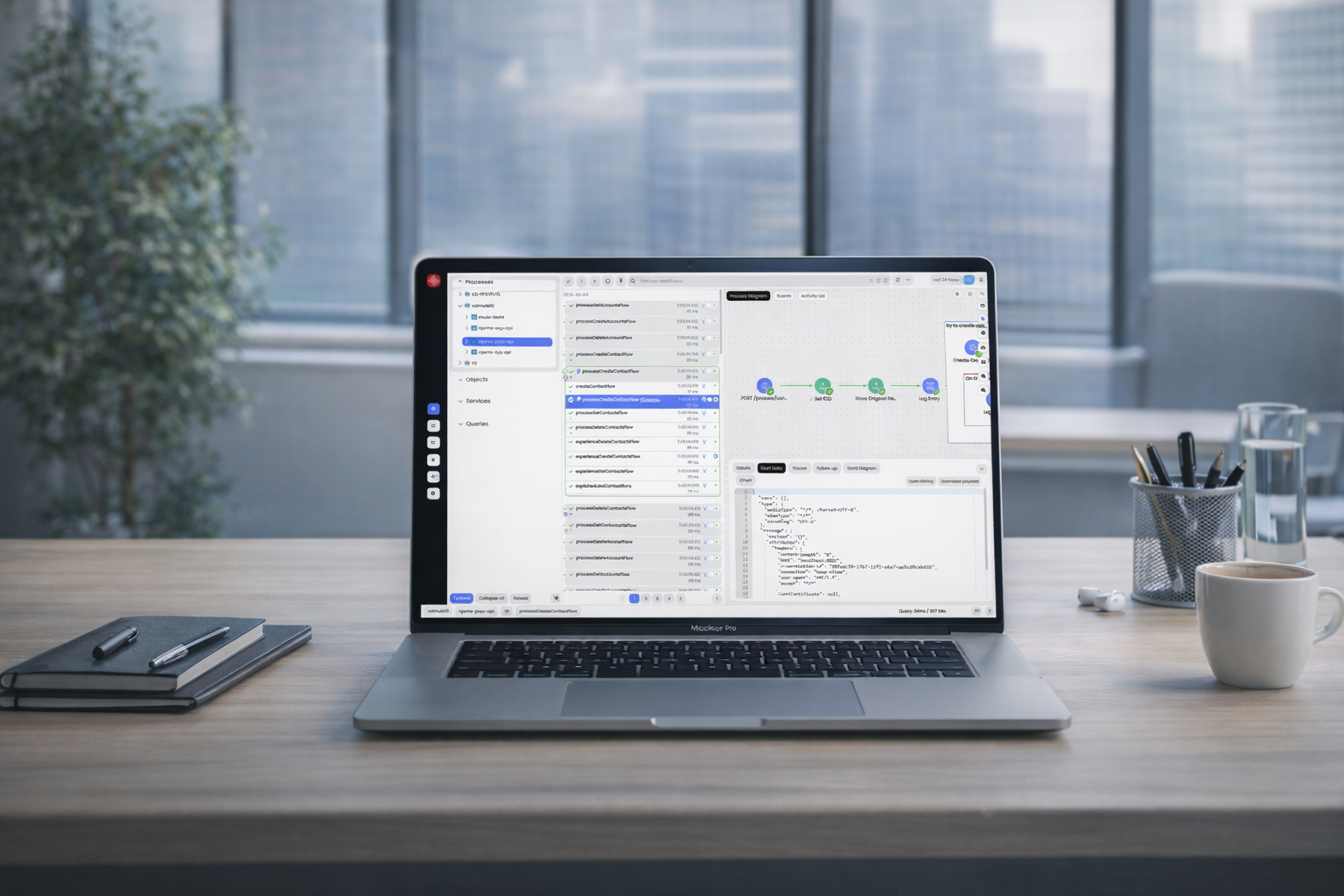

Open Source
Open Source
Connect systems, data, and processes seamlessly: With open source, you create a flexible, license-free integration foundation for greater efficiency, scalability, and independence.
Salesforce
Additional integration solutions

Expertise
We are your integration partner
With Salesfive, you have an integration partner by your side who brings together technology, processes, and business objectives—delivering solutions that not only work, but create real added value.

Technology focused on your business
Technology focused on your business
We don’t think of integration in isolation from IT, but always in the context of your processes, data flows, and business objectives.

Experience with complex system landscapes
Experience with complex system landscapes
Whether CRM, ERP, e-commerce, marketing, or legacy systems: We connect existing technologies into a powerful, scalable overall architecture.

Consulting, implementation and continuous development from a single source
Consulting, implementation and continuous development from a single source
From the strategic selection of the right solution through implementation and optimization, we provide end-to-end support for integration projects.

Tailored solutions instead of standard recommendations
Tailored solutions instead of standard recommendations
We provide technology-agnostic consulting and identify the integration approach that aligns with your requirements, your architecture, and your growth.

Let’s work together to find the right integration solution for your company.
Knowledge
Further articles on integration


FAQ
You have the questions – we have the answers
Our experts have answered the most frequently asked questions about integration for you.
An integration solution connects applications, data, and processes across system boundaries to ensure information flows consistently and workflows don’t end in silos.
In practice, this means: CRM, ERP, e-commerce, marketing, or service systems work seamlessly together instead of operating side by side. For companies, integration is therefore not purely an IT topic, but the foundation for efficient processes, reliable data, and scalable growth.
Companies need integrations because, without them, modern system landscapes quickly lead to media discontinuities, manual workarounds, and inconsistent data. Integration is therefore a key lever to reduce data silos, automate processes, and bring applications, data, and services together in a structured way.
For companies, this means: less operational friction, better decisions based on consistent data, and greater speed in customer-relevant processes.
In principle, almost all mission-critical systems can be integrated, provided suitable interfaces, APIs, or integration patterns are available. Typical examples include CRM, ERP, e-commerce, PIM, marketing, service, or legacy systems.
Salesforce and MuleSoft platforms and architectures demonstrate that integration today goes far beyond simple point-to-point connections, bringing together applications, data, workflows, APIs, and hybrid landscapes spanning cloud and on-premises.
What matters, therefore, is less whether systems can be integrated, and more what the right architecture for doing so looks like.
An API is a defined technical access method to a system’s data or functions.
An interface is the more general term for the connection between two systems.
Integration goes one step further: it ensures that data, processes, and logic work together across systems—including orchestration, transformation, governance, and monitoring. That’s exactly why, in many projects, it’s not enough to simply “build an interface”; what’s needed is an integration approach that fits the overall system landscape and the business processes.
Which integration solution is right for your company depends primarily on your starting point: the complexity of your system landscape, the integration volume, the need for API management, transparency, monitoring, flexibility, and governance. There are many tools available for integration initiatives, but not every tool is suitable for every project.
This is precisely where an experienced partner adds value: we don’t assess requirements in isolation from a purely technical perspective, but in the interplay of processes, architecture, and business objectives—and we recommend the solution that fits your needs today and remains viable tomorrow.