
Implementation and further development of your CRM platform
We implement Salesforce architectures in a structured and scalable way—from initial rollouts to the ongoing enhancement of your existing cloud environment. Performance, efficient processes, and long-term stability are at the core.
Implement Salesforce in a structured way and evolve platforms in a future-proof manner
We support companies in getting started with the Salesforce ecosystem and strategically evolve existing systems. The result is a system architecture that clearly reflects your business objectives, scales with your organization, and remains maintainable over the long term.
Your processes set the direction. Together, we analyse how your organisation operates and translate these workflows into a clear digital structure. This ensures long-term stability, reduces costs, and makes future adjustments easier.
We plan integration and data models from the outset to ensure your system runs without redundancies. We seamlessly connect your existing system landscape to Salesforce—from your ERP system and marketing tools to custom applications. The result is a multi-cloud environment in which various Salesforce products work together efficiently across your processes.
So your company can grow, we establish structures that meet international requirements while still allowing for local specifics. This enables you to scale rollouts across countries and organizational units in a controlled and efficient way.
Depending on the project, we combine traditional and agile methods. This gives you planning certainty for budget and timeline while also creating the flexibility to respond quickly to changes.

Florian Gehring
“Implementation and ongoing development mean building and evolving Salesforce so that it runs reliably today and scales with your requirements tomorrow.”
Pain Points
Where implementations and platforms reach their limits
Historically evolved customizations, a lack of release structures, and unclear integration principles cause Salesforce environments to lose stability and scalability.

Fragmented Salesforce Architecture

Opaque integrations

Missing Release and DevOps Structures

Extensive changes
Does your Salesforce environment have optimization potential?
As part of a Health Check, we assess your integrations, release structures, and multi-cloud capabilities in a structured and transparent manner.
Project timeline
Structured implementation in four phases
From the technical elaboration of the target architecture through to continuous evolution: our projects follow a clearly defined approach with a focus on stability, integrability, and scalability.

Process & Architecture Design
Process & Architecture Design
We analyze existing systems, translate the target architecture into a technical concept, and define data models, roles, and interfaces for implementation.

Implementation and Integration
Implementation and Integration
We configure, enhance, and develop Salesforce in line with clear architectural principles, integrate third-party systems in a structured manner, and deliver migrations in a controlled way.

Testing and Enablement
Testing and Enablement
We ensure quality with clear testing concepts, establish release processes, and enable business units and admin teams to operate the platform independently.

Scaling and further development
Scaling and further development
After go-live, we continue to evolve the platform in a targeted way, optimize performance, modernize existing structures, and use DevOps approaches to build the foundation for stability and growth.
Salesforce Solutions
Salesforce technologies operationally implemented and integrated
We implement Salesforce solutions in a structured manner, integrate existing system landscapes, and further develop platforms in line with clear architectural principles.



MuleSoft and API Integration
MuleSoft and API Integration
API-based integration architectures connect Salesforce with ERP, PIM, and other third-party systems.
Use Cases
How process and technology consulting provides tangible support to companies
Whether it’s a new implementation, modernization, or integration, we create the structural and technical foundations to ensure Salesforce systems are stable, scalable, and future-proof.

Structured Salesforce Re-Implementation
Structured Salesforce Re-Implementation
Implementing Sales or Service Cloud requires clear data models, role structures, and integrations. A clean technical implementation establishes stable processes and prevents architecture issues down the line.

Modernization of Salesforce Instances
Modernization of Salesforce Instances
Historically evolved adaptations and complex workarounds are slowing further development. Through refactoring and clear architectural principles, the platform becomes maintainable and scalable again.

Expansion of multi-cloud architectures
Expansion of multi-cloud architectures
New clouds or country rollouts increase complexity. Consistent orchestration across Sales, Service, Experience, or Data Cloud ensures stability and scalability.
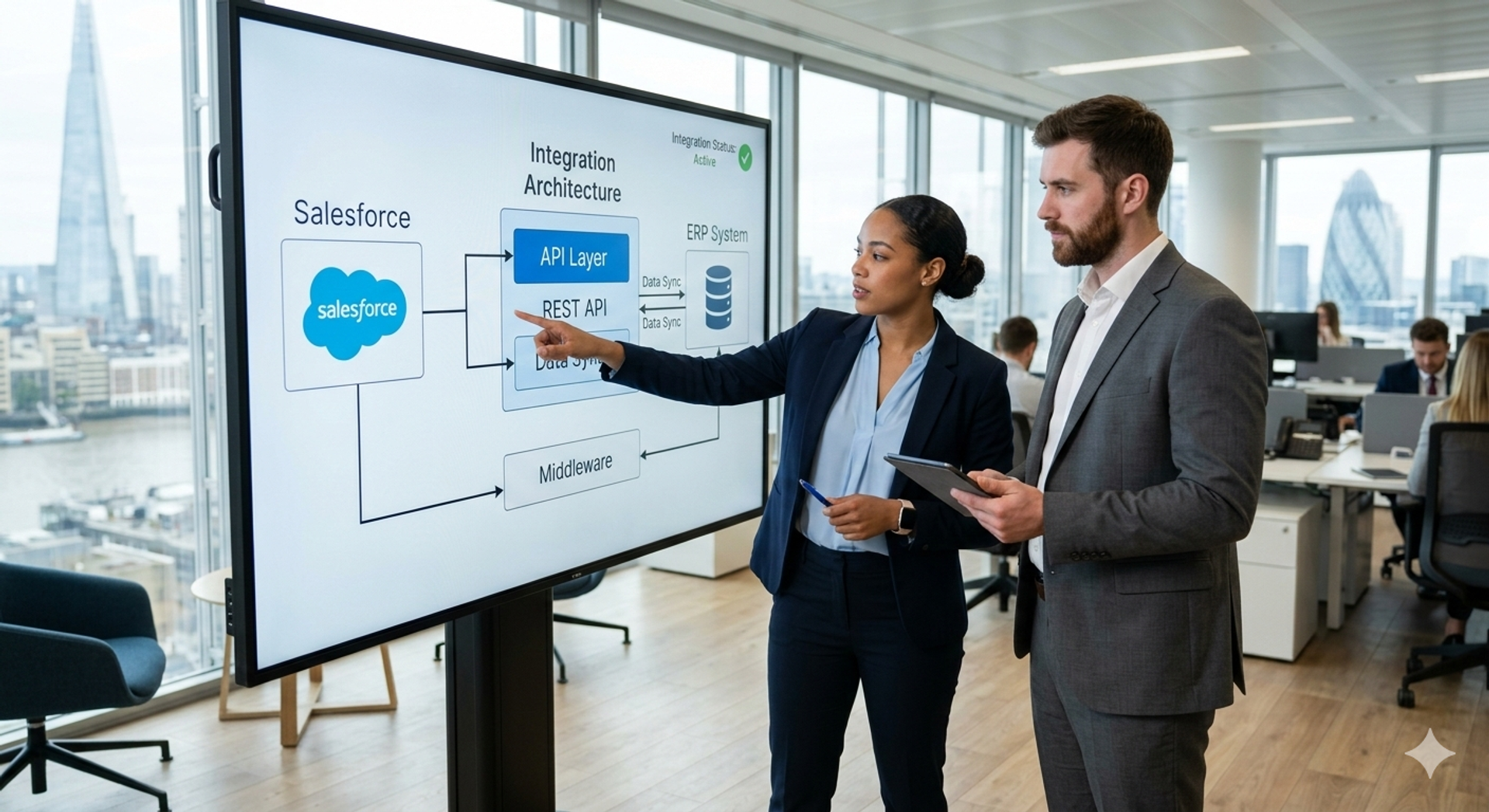
Integration of ERP and third-party systems
Integration of ERP and third-party systems
Missing or unstable interfaces lead to inconsistencies and require manual data maintenance. API-based integrations create transparency and reliable data flows.

Establishment of release and DevOps structures
Establishment of release and DevOps structures
Unstructured deployments increase risk and slow innovation. Clear CI/CD processes and testing strategies enable controlled, continuous improvement.

Implementation and Scaling of Data 360
Implementation and Scaling of Data 360
Data sources must be consolidated and identities cleanly linked. A structured integration creates a solid foundation for automation and analytics.
Customer Stories
Implementation and continuous improvement projects from practice
Technical challenges such as integrations, multi-cloud architectures and data harmonization are addressed in a project context with a clear focus on architecture and delivery.





Technologies
Technologies for Stable Salesforce Architectures
We implement and integrate Salesforce solutions based on clear architecture principles—scalable, maintainable, and aligned with existing system landscapes.


Agentforce Experience
Connect customers, partners, and employees on a platform for personal experiences, efficient collaboration, and measurable growth.

MuleSoft
Seamlessly connect systems and data: With MuleSoft, you can centrally integrate applications, APIs, and workflows for greater efficiency, automation, and growth.

FAQ
You have the questions – we have the answers.
We know that implementation projects are complex. That’s why we’ve compiled and answered the most frequently asked questions for you.
The duration depends on the scope, the number of integrated systems, and the desired process complexity.
Smaller implementations can be delivered within a few months, while multi-cloud or international rollouts require significantly more time. What matters most are clear requirements, defined architecture principles, and structured project phases.
Yes, in many cases, a structured evolution of existing Salesforce instances is even more sensible than a complete restart. Refactoring—optimizing code without functional changes—cleaning up customizations, and clear architecture guidelines can make even long-established instances maintainable and scalable again.
Modern implementations rely on API-based integration architectures. Structured interfaces ensure consistent data synchronization and cross-system process orchestration. Comprehensive documentation and clearly defined responsibilities ensure long-term stability.
Defined DevOps and CI/CD processes ensure that changes are tested and deployed in a traceable manner. Clear environment structures, test strategies, and deployment standards reduce risk and increase release velocity.
Multiple Salesforce Clouds should not be implemented in isolation. A consistent data and integration architecture ensures that processes remain stable across Clouds and that enhancements are delivered in a controlled manner.
After implementation, continuous improvement begins. Performance optimization, new requirements, additional integrations, and organizational adjustments are systematically embedded in a release and governance model.
More of our services

Data and AI
Experience how artificial intelligence, data-driven strategies, and practical implementation can help you automate processes, make informed decisions, and create sustainable added value for your company.

Intergration and automation
Connect and accelerate your service and business processes with integrated systems, intelligent automation, and a central database. For greater transparency, flexible scalability, and compelling customer experiences.

Change Management
Your transformation – strategic, inspiring, successful: learn how to shape change processes, engage employees, and achieve long-term transformation through change management, targeted communication, and a clear vision.